
Braille learning that feels joyful, not clinical
Brailly exists so blind and low-vision learners can explore braille with curiosity, while families and educators stay in the loop. We believe tactile literacy should adapt to every learner’s rhythm.
Built at the table, shared with the community
Brailly has travelled beyond the workshop so people can hold the prototypes, ask questions, and help shape what comes next.
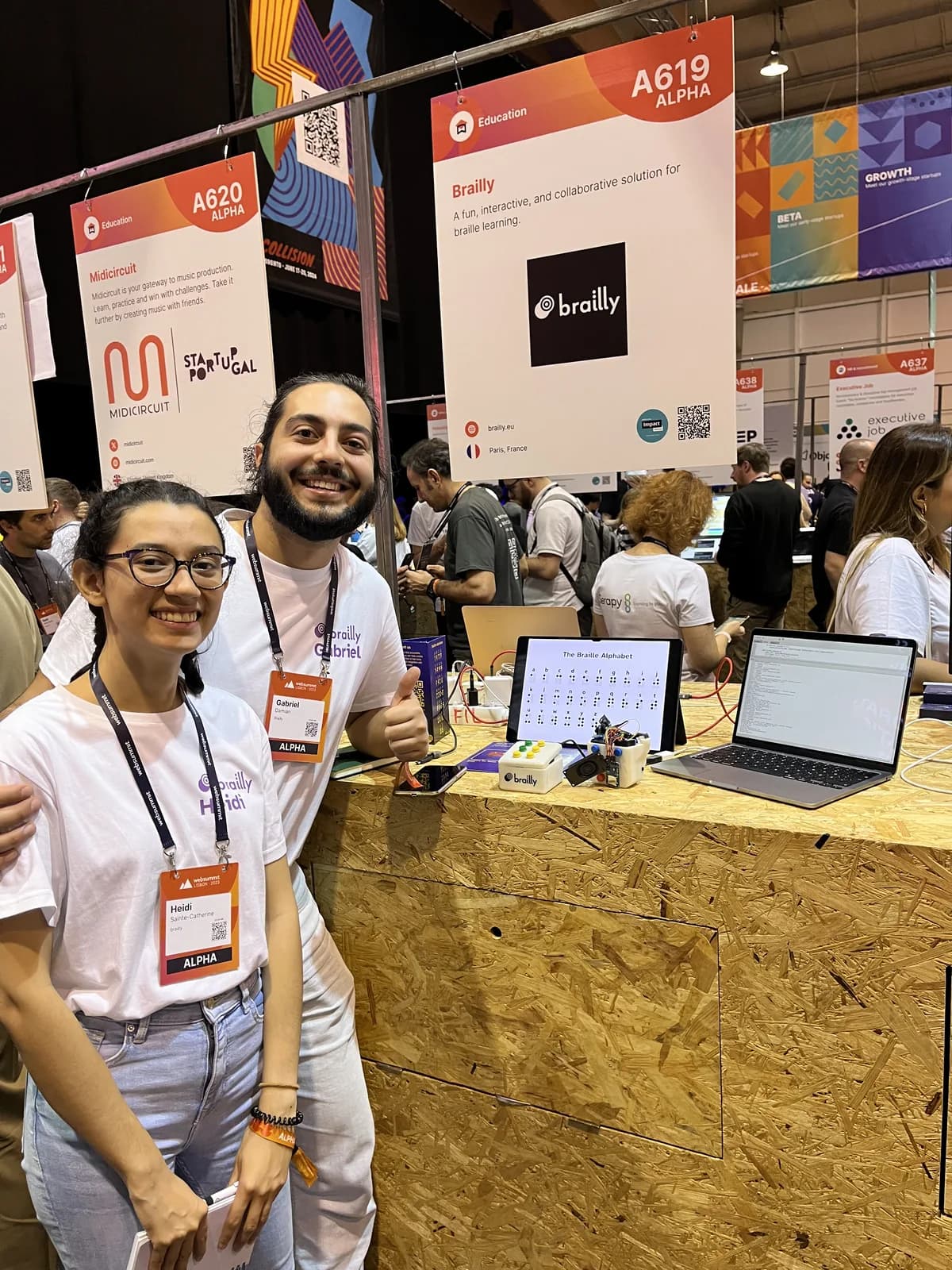
Web Summit · Lisbon, 2023
Sharing the white prototype at the Alpha startup booth.
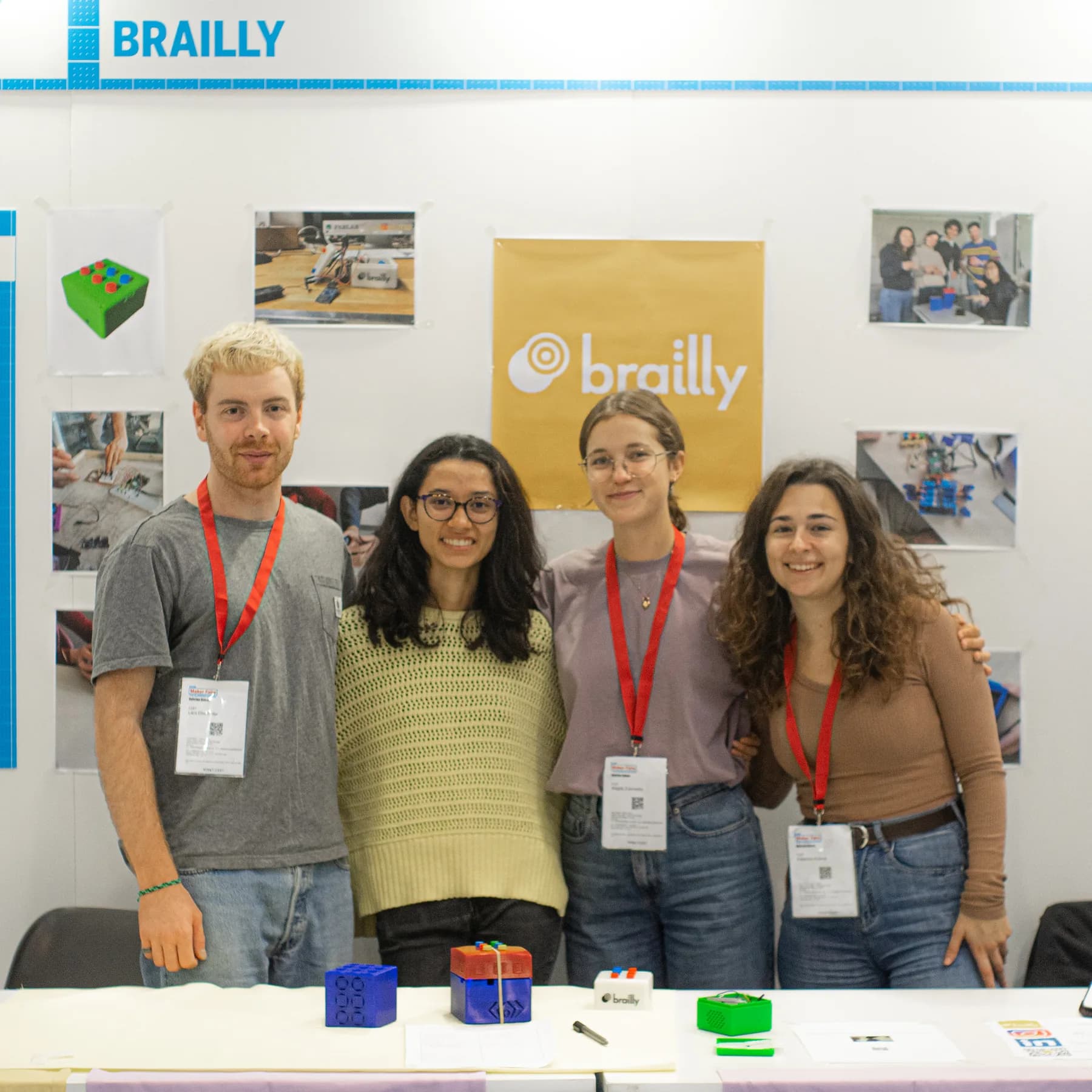
Maker Faire · 2023
The team with several generations of Brailly prototypes.
Tactile-first design
Brailly was shaped by hand alongside blind and low-vision learners so it feels intuitive from the first touch.
Built with the community
We tested early units with the Finnish Association of the Visually Impaired in Helsinki, rather than designing in a vacuum.
Sustainable by design
The casing is 3D-printed in biodegradable PHA filament—sturdy enough for a classroom and kinder to the planet.
The people behind Brailly
A small group across design, hardware, and product built the prototypes with feedback from blind and low-vision users.

Lars Oberhofer
Product, UX & hardware

Heïdi
Design & user research

Gabriel
Hardware & firmware
From a student project to a working prototype
Brailly grew in tight loops with blind users, educators, and two startup incubators. Here's how the journey unfolded.
Started at EIT Digital
Brailly began as an EIT Digital Master School project in Paris. The first tactile prototype used a Raspberry Pi Pico with buttons and on-device audio.
Tested with the community
Partnered with the Finnish Association of the Visually Impaired in Helsinki and ran workshops. A Sustainability Action Booster grant funded more units, 3D-printed in biodegradable PHA.
Through two incubators
Took part in the Aalto Creatives pre-incubator and the SIBB Incubator in Berlin (with HTW), which led to a €5,000 EIT Digital grant.
Rebuilt for the cloud
Moved to an ESP32-S3 device with a Next.js backend and spoken audio coaching—the current prototype.
Interested in Brailly’s next chapter?
Brailly remains an early-stage project. We’re happy to hear from schools, researchers, and makers interested in the work or a future prototype iteration.